
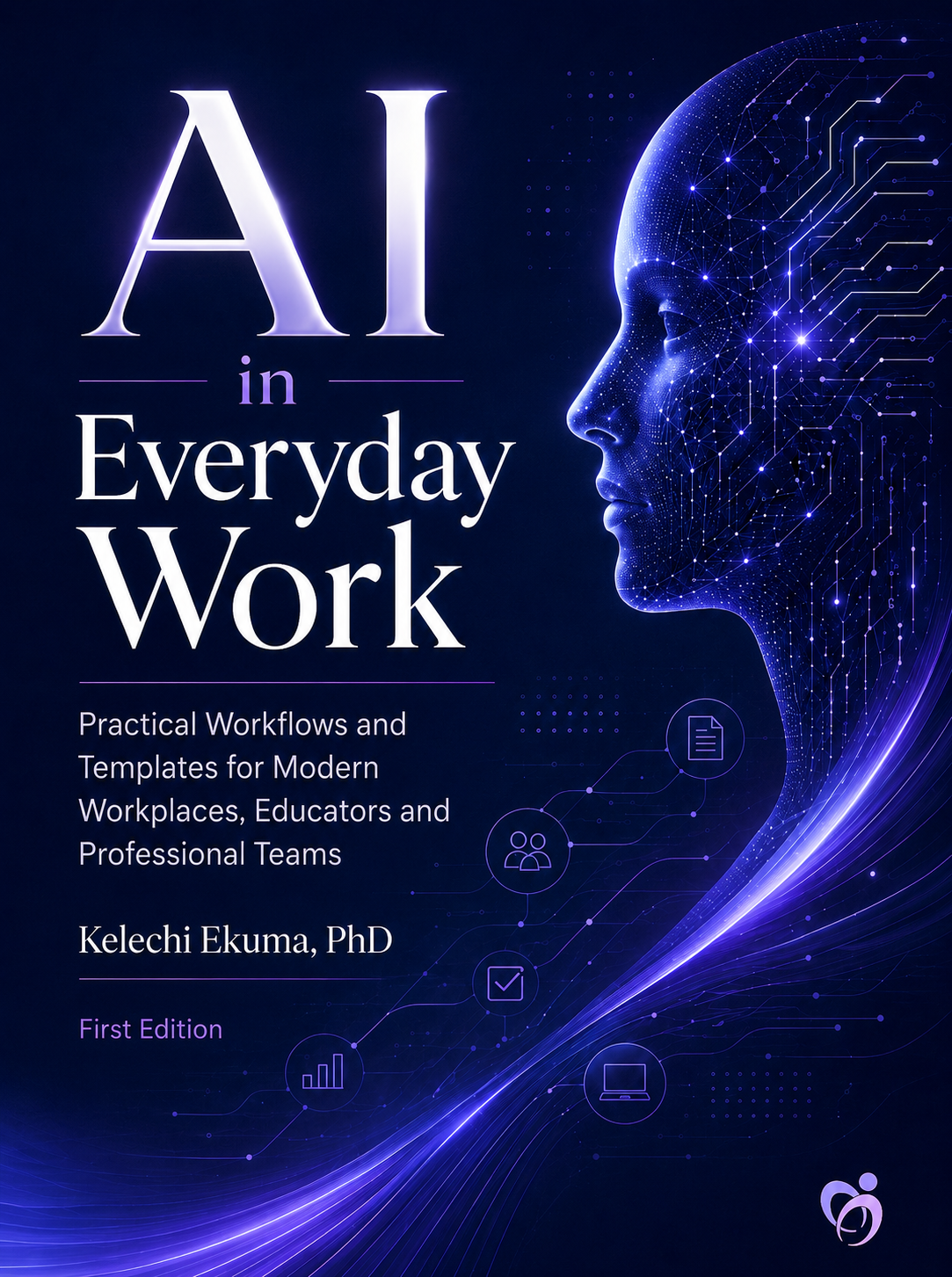
AI in Everyday Work
Practical workflows and templates for modern workplaces, educators and professional teams.
An operating system for AI-assisted work — from prompt design to verification, governance and agentic delegation. Built around the DEFINE framework, ten chapters of field-tested workflows, and a downloadable toolkit you can drop into Monday morning.
By Kelechi Ekuma, PhD · Manchester · March 2026
- 196pages
- 10chapters
- 28figures + tables
- 9templates

A working manual, not another AI explainer.
Three principles shape every chapter, every template and every quality gate in the book.
Evidence-led
Every claim is sourced. Workflows are calibrated against the empirical record on AI-assisted work — Noy & Zhang, Brynjolfsson, OECD, ILO, NIST.
Workflow-first
Not another AI explainer. A generic workflow template, ten chapters of role-specific procedures and nine reusable checklists.
Built for judgement
Verification, attribution and accountability are first-class concerns. Fluency carries no evidential weight — the workflow makes sure of it.
DEFINE.
Six moves that convert good practice from memory into sequence.
Define the goal
State what the task is, what success looks like, who the audience is and what constraints apply. Make it measurable — 'a 300-word board summary covering three risks' rather than 'summarise this'.
Establish context
Provide background, source material, examples and institutional rules. Context is the single strongest lever on output relevance — and the stage where sensitive data are screened out.
Format the prompt
Specify what the model should produce, in what style, to what length and with what structure. Explicit output specifications reduce iteration and make review easier.
Interact and iterate
Review, identify weaknesses, refine the request, improve across rounds. Ask the system to critique its own draft — then judge that critique critically rather than accept it at face value.
Navigate ethics
Assess bias, privacy, fairness, confidentiality and appropriateness against a live risk register. Outputs that fail this checkpoint do not proceed.
Embed into workflow
Verify claims, add citations, document decisions, secure sign-off, route through the relevant quality gate. Un-embedded output is the raw material of the shadow-AI problem.
Ten chapters. One coherent practice.
From first principles through role-specific workflows to agentic delegation and governance — each chapter ends with a practical exercise and links to a downloadable template.
The Rise of Generative AI at Work
Adoption, evidence and why a practical operating system is now needed — with a note on equity and the Global South.
An Operating System for AI-Assisted Work
Task suitability, maturity, the DEFINE framework and the generic workflow template that anchors the rest of the book.
Foundations of Generative AI
What models can and can't do, prompt design, iteration patterns and the anatomy of a confabulation.
Research and Writing Workflows
Literature scouting, academic drafting, fact-checking, qualitative summarisation and QA gates calibrated to scholarly standards.
Communication and Productivity
Email drafting, meeting agendas, note-taking, time-management — and the voice and boilerplate problem.
Data Analysis and Decision Support
AI-assisted coding and analysis, data cleaning, decision support and reproducibility routines for analysts.
Education-Specific Workflows
Lesson planning, assessment design in the age of AI, feedback, study assistants and drafting institutional AI policies.
Team Collaboration and Project Management
Project planning, risk assessment, collaboration guidelines, progress monitoring and disciplined ideation.
Agentic AI: Working with Systems That Act
The autonomy ladder, moving from prompts to missions, and practical oversight of systems that take real actions.
Governance and Responsible Use
International landscape, quality-assurance framework, bias mitigation, privacy, fairness evaluation and incident response.
Chapter 4
Research & Writing Workflows
The zone where generative AI delivers its largest measured gains — and where the stakes of failure are highest and most distinctive.
- Anchor before you scout: verified cornerstone sources give you the baseline to judge AI suggestions.
- Every AI-suggested reference is fictional until a database says otherwise.
- Confine drafting AI to facts you supply; forbid invention explicitly in the prompt.
- Calibrate verification depth to consequence, and never forward unverified material.
- Synthesis, interpretation and authorship are human, disclosed and accountable.
Research and writing are foundational activities in academia, policy and corporate environments, and they sit squarely inside the zone where generative AI delivers its largest measured gains. Controlled experiments show professional writing completed roughly 40 per cent faster and rated meaningfully higher in quality with AI assistance.
Yet research is also where the stakes of AI failure are highest and most distinctive. The currency of scholarship is the verified claim; the reputation of a researcher, an evaluator or an institution rests on the integrity of what is asserted and cited. Generative models threaten that currency in three documented ways. They fabricate references and details with perfect fluency. They compress complexity in ways that can silently distort findings. And, more subtly, they can create what Messeri and Crockett (2024) call illusions of understanding: the sense of having surveyed a field when one has actually surveyed a model's synthesis of it.
"In research, AI accelerates the production of candidate text and candidate structure, while humans own every claim."
None of these risks argues against using AI in research. All of them argue for using it inside a workflow whose checkpoints were designed with them in mind.
Nine functional templates.
Straight from the chapters.
The DEFINE workflow, the master prompt scaffold, the verification loop and the research and collaboration logs — each in PDF, DOCX, XLSX and CSV, ready to fork.
DEFINE Workflow Checklist
Sequence any AI-assisted task through the six DEFINE stages with quality gates at Context, Ethics and Embed.
Master Prompt Scaffold
The seven-component prompt template — Role, Task, Context, Audience, Format, Constraints, Quality behaviours.
Verification Loop Log
Log every AI-suggested claim and reference against an independent source before it enters a document.
Literature Search Tracker
Record cornerstone sources, search terms, databases and rejection reasons for an auditable synthesis.
Source Verification Checklist
Provenance, corroboration and currency checks — calibrated to the stakes of the claim being made.
Prompt Iteration Log
Capture what you asked, what came back, what you refined — building institutional prompting memory over time.
Collaborative Drafting Log
Track shared drafts, AI contributions, human edits and disclosure notes across a team of authors.
Meeting Agenda & Minutes
AI-assisted agenda, decision log and action items — with an explicit column for what the AI touched.
AI-Task Risk Register
A live register of AI-specific risks per task, with likelihood, impact, mitigation and review dates.
“The teams that get the most from AI are not the ones that write the longest prompts. They are the ones that build the clearest checkpoints.”
Built for practitioners, grounded in the field.
Kelechi Ekuma, PhD writes on technology, work and institutions from the University of Manchester. AI in Everyday Work distils years of teaching, consulting and field research into an operating system that professional teams can actually run — rather than another survey of what AI might eventually do.
The book is deliberately cross-sector. Its workflows have been calibrated with researchers, evaluators, educators, developers, policy analysts, project managers and the mixed teams that hold most organisations together — including the ones outside the OECD frontier.
Good questions.
Add the operating system your AI use has been missing.
The ebook is DRM-free PDF, delivered instantly. Every copy unlocks the private companion site with all nine templates, updates and errata.